Observation of the Higgs boson's production mode 'ttH' in the bottom-quark decay channel
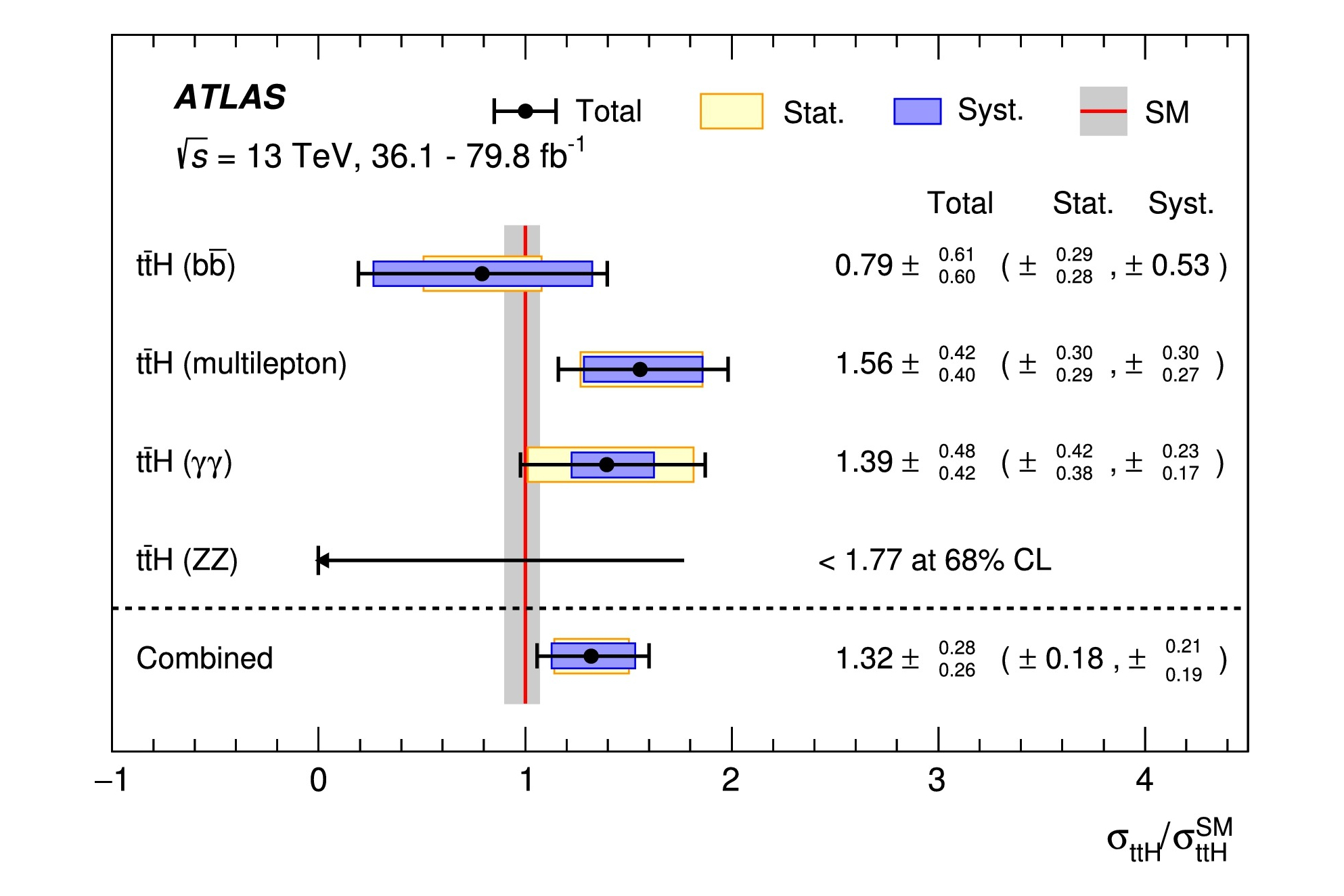
The cross section relates to the rate of the process (how often it occurs). It is compared with the prediction of the Standard Model (SM), the theoretical framework of particle physics. A ratio of 1 (vertical red line) means that it is consistent with theoretical predictions. The horizontal spread is due to uncertainties (an interval of possible values as no detector is 100% precise). The analysis had different channels depending on the Higgs boson’s decay mode. I was involved in the one where the Higgs boson decays into a pair of bottom and antibottom quarks, the first line ‘ttH(bb)’ in the plot.
Learn more
This analysis was refined by ATLAS collaborators later, and in 2024 a more precise result was published. Here is the ATLAS briefing ↗ (accessible for newcomers).